In music production, audio compression is key to shaping sounds. It’s crucial to know how compressors work and their role in mixing. So, what’s a compressor’s job in music? It makes audio tracks sound polished by reducing their dynamic range.
Whether you’re new or experienced, learning about compression is important. This article will cover how compressors are used in music production. We’ll look at their use in tracks, mix buses, and mastering chains.
Key Takeaways
- Audio compression narrows the dynamic range for a polished sound.
- Compressors are indispensable in various stages of music production.
- Understanding compressor parameters is vital for effective use.
- A moderate ratio of around 3:1 is commonly applied.
- Release times typically vary between 40 milliseconds to 2 seconds.
What is Audio Compression in Music Production?
Audio compression is key in music production. It helps make tracks sound better by controlling loud and quiet parts. This makes the final mix sound more polished and cohesive.
It works by adjusting volume levels automatically. Knowing about threshold and ratio is important. Threshold is in decibels (dB) and shows when compression starts. Ratio tells how much signal is reduced, with 3:1 or 5:1 being common.
Limiters are special compressors that control loud peaks. They can have high ratios like 10:1. Attack and release settings also play a big role, with attack times in milliseconds (ms).
Different compressors are used for different sounds. Tube compressors add warmth, while optical ones use light to manage signals. FET compressors are fast and reliable, and VCA compressors are clear and flexible.
Knowing how to use these tools is crucial. It’s not just about the price of the compressor. It’s about how well you use it to control dynamic range.
What Does a Compressor Do Music?
Understanding a compressor’s role in music starts with its function in audio engineering. It acts as an automatic level controller. When sound gets too loud, it reduces the volume peaks. This makes the mix sound smoother and improves sound quality.
With the right use, compression is key to making professional-sounding music.
Defining Dynamic Range Compression
Dynamic range compression adjusts audio signal volumes, focusing on loud peaks. It ensures soft and loud parts blend well without one dominating. The compression ratio shows how much gain is reduced when signals exceed a threshold.
For example, a 3:1 ratio means a 3dB increase in input results in only a 1dB increase in output. This clearly shows how compression works.
How Compression Affects Sound Quality
Compression balances audio signals, making sound quality better. It reduces loud parts and boosts quiet ones. This makes the mix clearer and more enjoyable to listen to.
Different compressors, like VCA, Opto, and FET, change the sound in unique ways. Settings like attack and release, and knee, shape how the compressor works. These elements are crucial in shaping the final sound, making compression essential in audio engineering.
| Compressor Type | Characteristics | Best Use Cases |
|---|---|---|
| VCA Compressors | Fast response, versatile | Drums, vocals |
| Opto Compressors | Smooth, warm sound | Vocals, bass |
| FET Compressors | Aggressive, punchy | Guitars, drums |
| Variable Mu Compressors | Natural warmth, vintage | Overall mixes, mastering |
Why Is Compression Important in Music Production?
In my experience, audio compression is key to making music sound great. It’s a vital part of music production, helping me create tracks that are clear and intentional. Knowing how compression works lets me control the song’s dynamics, making the final product sound polished.
Creating Professional-Looking Tracks
Compression shapes the sound of my music by managing the dynamic range. It boosts the volume of quiet parts and controls loud peaks for a balanced mix. This balance is crucial for engaging listeners, not pushing them away with sudden volume changes.
Using different compressors, like VCA, tube, or optical, adds unique sounds to my tracks. This variety helps me make professional-sounding music.
Enhancing Musical Elements
Compression is essential for highlighting key musical parts. By tweaking attack and release, I control how fast the compressor reacts. This affects the track’s rhythm and feel.
This control also keeps the music’s energy high while ensuring all parts blend well. Compression is a tool for refining the mix, making sure every element is clear and adds to the overall sound.

| Compressor Type | Characteristics | Common Applications |
|---|---|---|
| VCA | Diverse control, fast response | General mixing, adding punch |
| Tube | Warmth, slower response | Vintage sounds, adding character |
| Optical | Smooth compression, musicality | Vocals, strings |
| FET | Bright and punchy | Rock vocals, drums |
Common Compressor Types Used in Music Production
In audio engineering, knowing about different compressors is key. Each type has its own special features. These help make music sound better.
Tube compressors are loved for their warm, vintage sound. They’ve been around since the 1950s. They add a rich quality to vocals and instruments, making them sound more like analog recordings.
Optical compressors, like the Teletronix LA-2A, use light to control sound levels. They give a clear, transparent sound. This is great for making music sound balanced without losing its quality.
FET compressors, like the 1176 model, are known for their fast action and clear sound. They’re perfect for making drums sound tight. Famous artists like Led Zeppelin and Michael Jackson have used them.
VCA compressors, such as the SSL G Bus, are versatile and precise. They’re used a lot in music production. They add punch to drums and guitars. Plugins like the SSL G-Master Buss Compressor show how important they are today.

| Compressor Type | Characteristics | Common Uses | Examples |
|---|---|---|---|
| Tube Compressors | Warm, vintage sound | Vocals, instrument tracks | UAD Fairchild Collection, Arturia TUBE-STA |
| Optical Compressors | Smooth, transparent | Gentle leveling | Universal Audio LA-2A, Waves CLA-2A |
| FET Compressors | Fast, clean results | Percussion, dynamic elements | Universal Audio 1176LN, Waves CLA-76 |
| VCA Compressors | Versatile, punchy | Drums, guitars, mix buses | SSL G-Master Buss Compressor, Cytomic The Glue |
Trying out different compressors can really improve your music. Each one has its own special use. Knowing this helps you pick the right one for your project.
Key Compressor Parameters and Their Functions
Knowing the key compressor parameters is vital for good audio compression in music making. Each setting is important for controlling the sound’s dynamic range. Understanding how these settings work helps me make better creative choices that improve the mix.
Understanding Threshold and Ratio
The threshold is where the compressor starts working. A higher threshold means less compression. A lower threshold means more compression happens sooner. The ratio shows how much compression happens after the threshold is reached. For example, a 4:1 ratio means the output only goes up 1 dB if the signal goes up 4 dB, controlling the sound better.
Exploring Attack and Release Settings
The attack time is how fast the compressor reacts to sounds. A quick attack can soften loud sounds, like drums. A slower attack lets some sounds through, adding punch. The release time is how fast the compressor stops working after the sound goes back down. A short release keeps the sound lively, while a long release makes it smoother.
The Role of Knee in Compression
The knee setting changes how the compressor moves between compressed and uncompressed sounds. A hard knee starts compression suddenly, while a soft knee does it gradually. This affects how the sound feels, letting you control its dynamics for a specific sound.
| Parameter | Description |
|---|---|
| Threshold | Levels needed to activate compression |
| Ratio | Degree of compression applied beyond the threshold |
| Attack | Speed of compressor response to incoming signal |
| Release | Time taken for the compressor to stop compressing after the signal drops |
| Knee | Naturally introduce compression, affecting sound transitions |
| Gain | Make-up gain to compensate for any reduction in output volume |

How to Use Compressors Effectively in Your Mixes
Mastering compression is key in music production. I aim to polish the sound while keeping it dynamic. Here are some strategies for using compressors well, for different parts of the mix.
Tips for Optimal Compression Settings
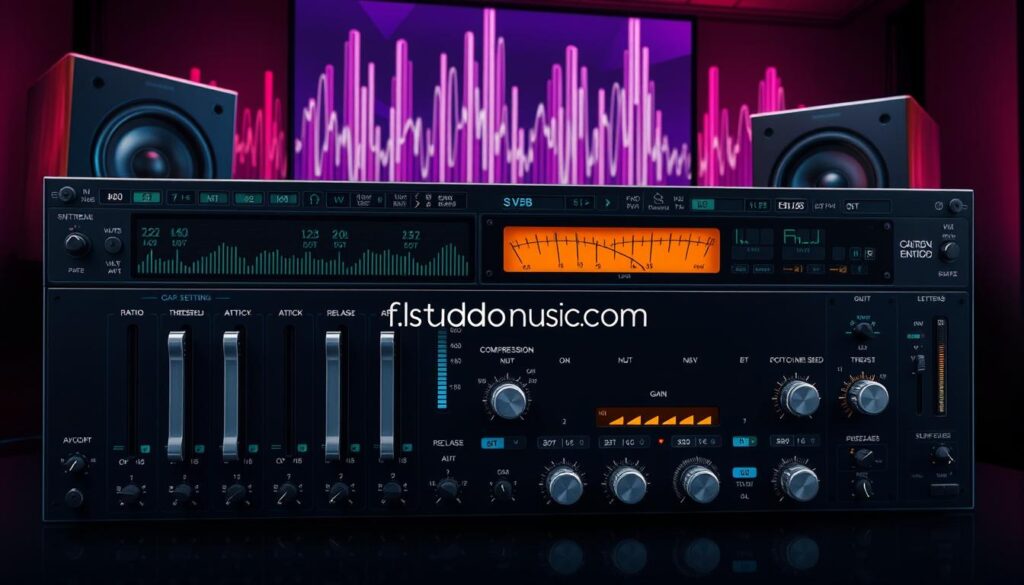
Knowing the basics of compression makes it easier. The four main settings are:
- Threshold: This is when compression starts.
- Ratio: This shows how much compression happens after the threshold.
- Attack: This is how fast the compressor reacts after the signal hits the threshold. For example, use 40ms for instruments and 6ms for vocals.
- Release: This is how fast the compressor stops after the signal drops below the threshold. Start with 60ms and adjust as needed.
Avoiding Over-Compression
It’s important not to over-compress, as it can make the mix sound dull. I always have a clear goal when using compression. Stacking compressors can help, and starting with a 3:1 ratio is a good place to begin. For louder sounds like kicks and snares, use higher ratios like 5:1 to 8:1.
Utilizing Make-Up Gain Properly
After using compression, make-up gain is crucial to keep the volume right. It helps the mix sound balanced and dynamic. To enhance the low end, compressing bass and kick drums together works well.
| Parameter | Recommended Starting Setting |
|---|---|
| Attack (Instruments) | 40ms |
| Attack (Vocals) | 6ms |
| Release | 60ms |
| Moderate Ratio | 3:1 |
| Heavy Ratio | 8:1 |
Advanced Compression Techniques for Music Producers
As a music producer, I’ve learned that mastering advanced compression techniques is key. Sidechain compression, parallel processing, and multi-band compression are essential tools. They help achieve a professional sound by adjusting the energy and clarity of your mix.
Sidechain Compression Explained
Sidechain compression lets one audio signal control another’s compression. It’s common in dance music, making the bass line duck under the kick drum. This creates a rhythmic effect. By using an external trigger, like a kick drum, I control when the compressor activates, enhancing the low end.
Parallel Processing with Compressors
Parallel processing is a powerful method for blending dynamics. It splits the audio into two paths: one is uncompressed, the other is heavily compressed. Adjusting the mix between these signals adds depth and volume without losing musicality.
Multi-Band Compression Techniques
Multi-band compression lets you control different frequency ranges precisely. It divides the audio spectrum into lows, mids, and highs. This technique enhances clarity and balances each frequency range, leading to a polished final product.
| Advanced Technique | Purpose | Application |
|---|---|---|
| Sidechain Compression | Create dynamic interactions between tracks | Used widely in genres like EDM |
| Parallel Processing | Blend compressed and uncompressed signals | Add depth and maintain dynamics |
| Multi-Band Compression | Control specific frequency ranges | Enhance clarity and balance |
Demystifying Compressor Controls
Understanding compressor controls is key for music production. It’s all about gain control and metering. These tools help keep audio balanced and improve its quality.
Understanding Gain Control
Gain control, or make-up gain, lets me adjust the signal level after compression. It makes sure the output is loud enough without losing mix quality. When I compress, the volume might drop. Gain control helps bring it back up, making the sound cohesive and polished.
The Importance of Compressor Metering
Metering is a vital part of the compressor’s job. It lets me see how the compressor is working. By watching levels, I can adjust the compressor to fit the audio’s dynamics. This careful monitoring prevents over-compression and keeps the track’s natural feel.
Compression in Mixing vs. Mastering
When I work on mixing and mastering, I see big differences in how I use compression. Both stages aim to improve sound quality, but they do it in different ways. Knowing how to use compression in mixing and mastering helps make music sound better and clearer.
The Role of Compression in Mix Buses
In mixing, I use compression on tracks and mix buses to balance the sound. I focus on a few key things when I compress:
- Threshold: This is when the compressor starts to work. For example, if it’s set at -4dB, it only kicks in when the sound gets louder than that.
- Ratio: This controls how much the sound is reduced. A 3:1 ratio, for instance, helps keep the mix lively while controlling loud parts.
- Attack and Release: Fast attack times make transients less harsh, while slower ones keep them sharp. This is important for a lively sound.
Using compression on the mix bus helps blend different sounds together. Engineers like Andy Wallace often use SSL4k bus compression to get a unified sound.
How Compression is Used in Mastering Techniques
In mastering, compression is used in a more subtle but important way. It helps make the whole track sound the same loudness. I use lower ratios and gentle settings to boost the track without losing its feel.
Here’s how compression works in mastering:
- Gluing Tracks Together: It makes all the parts of the track sound like they belong together.
- Enhancing Tonality: Small changes can make a big difference in the track’s feel and sound, bringing out certain notes and sounds.
- Avoiding Over-Compression: Too much compression can make the track sound flat, so it’s important to find the right balance.
Think of it like this: compressing tracks gives you different sounds, but compressing the master bus makes the whole track sound unified.
| Aspect | Mixing Compression | Mastering Compression |
|---|---|---|
| Purpose | Control dynamics of individual tracks | Ensure overall consistency and loudness |
| Techniques | Individual track control, glueing mix buses | Subtle adjustments, gentle ratios |
| Typical Settings | Moderate ratios, targeted frequency control | Lower ratios, broad frequency impact |
| Outcome | Balanced mix with dynamic range | Cohesive track that maintains punch |
Understanding these differences helps me do better in audio engineering. Using compression well in mixing and mastering makes music sound polished and engaging to listeners.
Common Mistakes to Avoid When Using Compressors
Working with compressors in music production can lead to common mistakes. These mistakes can affect the sound quality of my mix. It’s important to know these pitfalls to achieve a polished final product.
Key areas to focus on include recognizing over-compression signs and choosing the right compressor types for the music.
Signs of Over-Compression
Over-compression can make tracks sound dull and lose dynamic impact. To avoid this, I watch for specific signs:
- Loss of transients, resulting in a flat sound.
- Unnatural pumping effects that disrupt the music’s flow.
- A muddy low-end, particularly in bass-heavy instruments.
Compression should make the mix better, not worse. I use automation to address dynamic range issues first. Then, I adjust the compressor settings to fit the mix’s needs.
Choosing the Wrong Compressor Type
Using the wrong compressor type can harm the sound quality. Different compressors have different sounds. It’s crucial to understand their functions in mixing.
I consider several factors when choosing a compressor:
| Compressor Type | Best Use Case |
|---|---|
| VCA Compressors | Versatile mixing tasks, good for controlling dynamics. |
| FET Compressors | Adding punch to drums and vocals. |
| Optical Compressors | Smooth, musical compression ideal for vocals. |
| Tube Compressors | Warmth and saturation for overall mix enhancement. |
Using the right compressor type improves individual elements and the overall sound. Knowing how to adjust ratios, attack, and release settings helps control dynamics while keeping the performance true.
Conclusion
Exploring compression in music production shows its key role in making tracks sound great. I’ve covered important points about compression’s role in audio engineering. This includes mixing, mastering, and live sound.
I’ve learned about different compressor types like VCA, Optical, FET, and Tube. Each type helps shape the sound of my projects in unique ways.
Knowing about compressor settings like threshold, ratio, and attack time helps me use them better. For example, a 4:1 ratio helps manage loud signals, making the sound smoother. By mastering these settings, I can improve the clarity and punch of my mixes.
My exploration of compression has shown it’s a powerful tool in audio engineering. Understanding its potential helps me fix mix issues and add creative effects. As I keep improving, I’ll use these insights to try new things and grow in my audio production skills.
FAQ
What is the purpose of a compressor in music production?
A compressor in music production helps even out audio levels. It adjusts volume to keep sounds consistent. This makes tracks sound better and easier to mix.
How does audio compression improve sound quality?
Compression helps control audio levels, making sounds clearer. It balances loud and soft parts, so everything sounds right together.
What are the common types of compressors used in music production?
There are many compressors like tube, optical, FET, and VCA. Each has its own sound and use. They help shape audio in different ways.
What key parameters should I understand when using a compressor?
Important settings include threshold, ratio, attack, release, and knee. Knowing these helps you use the compressor right.
How can I avoid over-compression in my mixes?
To prevent over-compression, watch your levels and keep dynamics. Be careful with ratio and attack/release. Always listen to your mix. Make-up gain helps keep levels even.
What is sidechain compression and how is it used?
Sidechain compression lets one sound affect another. It’s used to make bass lines duck under kick drums. This improves mix clarity.
What is the difference between mixing and mastering compression?
Mixing uses compression on tracks for balance. Mastering uses it on the whole track for loudness. Knowing this helps in audio engineering.
Source Links
- https://www.uaudio.com/blog/audio-compression-basics/?srsltid=AfmBOop2LZ5SGjH3kd33sQICiPz7BNnNJOjpebGe5oKyq9BnGjhCf5bb
- https://splice.com/blog/what-is-compression/
- https://www.uaudio.com/blog/audio-compression-basics/?srsltid=AfmBOopSMUIH_jG6u_w56AD1AUU9Y-xQFVb3yMnC8Q7NUy5tvXABxqAa
- https://musictech.com/guides/essential-guide/beginners-guide-to-compression/
- https://blog.landr.com/how-to-use-a-compressor/
- https://www.hollyland.com/blog/tips/what-does-a-compressor-do-in-music
- https://www.wavealchemy.co.uk/blog/understanding-compression/
- https://pirate.com/en/blog/music-compression/
- https://www.uaudio.com/blog/audio-compression-basics/?srsltid=AfmBOoor6Ibln-k_R2cZySlbxcoiVPhCcOyr9p5AOYPZimudeoO9ezgd
- https://blacktidemusic.com/software-and-plugins/understanding-audio-compression/
- https://dynaudio.com/magazine/2023/august/demystifying-the-compressor
- https://teropotila.com/what-does-a-compressor-do-in-music
- https://www.theaudiopod.com/blog/iqwtoxn3y22jpr1rcilk7gr6uuozkp
- https://mastering.com/how-to-use-a-compressor-plus-10-top-tips/
- https://www.audio-issues.com/music-mixing/the-complete-guide-to-using-compression-correctly-in-your-mixes/
- https://www.uaudio.com/blog/audio-compression-basics/?srsltid=AfmBOoqUjzBhFWajz7uGPUy04zJLU1oHmoE1MlXOZNh_IxIQS4CMAXIp
- https://www.soundgym.co/blog/item?id=audio-compression-explained
- https://www.renegadeproducer.com/audio-compression.html
- https://www.musicsequencing.com/article/compression-explained-and-demystified/
- https://www.masteringthemix.com/blogs/learn/unlocking-the-power-of-compression-in-audio-mastering?srsltid=AfmBOopTXsmHMuDm2fHF2WiIKlTc4KkZylJ9lfP6MMQyrJGiI_XWsked
- https://www.masteringthemix.com/blogs/learn/what-is-audio-compression?srsltid=AfmBOorfV40VwLJml-m4lItfWkKdLs6yy_0Z5G87MiiMOGYk9c72rIqP
- https://gearspace.com/board/rap-hip-hop-engineering-and-production/721271-difference-between-compressing-master-individual.html
- https://www.masteringthemix.com/blogs/learn/7-compression-mistakes-that-can-ruin-your-music?srsltid=AfmBOorZwij610VTnH0f9kXQ-qP3kFAWV7bkBPelhVJwPknQRPTerP0D
- https://blog.landr.com/use-compression-solve-5-common-mixing-mistakes/
- https://upstairstudio.com/what-does-a-compressor-do/
- https://www.masteringthemix.com/blogs/learn/what-is-audio-compression?srsltid=AfmBOopKsdALro0RVtmebCujJ3BAhLDqkW__W2AVwLfvXyonbVVTx8JO
- https://5piecemusic.com/what-is-compression/