In musical notation, arranging elements like time signatures, bars, and measures is key. Beats per bar is central to rhythm and flow. The time signature tells us how many beats are in a bar, guiding musicians.
Music bars often have four beats, thanks to the 4/4 time signature. This is known as common time. Bar lines help separate music into parts, aiding in keeping rhythm.
Knowing about time signatures is crucial in music theory. It helps us understand meter in music. This article aims to explain beats per measure and their role in music.
Key Takeaways
- The most common time signature in music is 4/4, known as common time.
- Other frequent time signatures include 2/4, 6/8, 3/4, and 3/8.
- 3/4 time is famously recognized as waltz time.
- Bar lines become crucial for maintaining rhythmic accuracy in music.
- Five types of bar lines help organize musical compositions effectively.
- Understanding beats per bar assists musicians in interpreting and performing pieces accurately.
The Basics of Time Signatures
Time signatures are key in music notation, shaping the rhythm and structure of a piece. They appear as two numbers. The top number shows the beats in a bar, and the bottom number shows the note value for one beat. For example, in 4/4 time, there are four beats in a bar, each a quarter note.
This creates a steady, marching rhythm found in many genres.
Common time signatures include:
- 4/4: Known as “common time”, categorizes four beats per measure.
- 3/4: Provides three beats per measure, commonly found in waltzes and folk music.
- 2/2: Also called “cut time”, features two beats per bar, where each beat equals a half note.
Irregular time signatures introduce unique rhythms. For example, 5/4 has five beats in a bar, offering a special structure. The 7/4 time signature, with seven beats, shows another unusual layout.
Compound time signatures like 6/8 have six beats in a bar, with the eighth note getting one beat. This time signature often feels like a “two-beat” rhythm. It’s popular in classical symphonies and rock music. Each time signature adds its own rhythmic texture and feeling to music.
Knowing these basics is essential for understanding more complex rhythms and structures in music. It helps me appreciate different compositions and styles more deeply.
Understanding Bars and Measures
In music notation, bars, or measures, are key parts that organize a song. Each bar has a set number of beats, based on the time signature. This helps composers arrange their music clearly.
The piece I looked at has 8 bars, with 2 beats in each, marked as 2/4. This means each beat is a quarter note. It helps both performers and listeners understand the rhythm.
Bar lines mark where the music staff splits into measures. They help keep rhythmic ideas in order. Measures start with a number, except for the first one and pickup measures.
At first, music didn’t use bar lines to show rhythm. Instead, it used section divisions. Bar lines became common in ensemble music in the late 16th century. By the mid-17th century, they were used more regularly.
Edward T. Cone introduced hypermeasures. They show each regular measure as one beat of a bigger unit. Famous composers like Igor Stravinsky saw bar lines as key to improving musical phrases.
The first complete bar is called “bar 1” or “m. 1.” Bars follow in sequence. Composers like Hugo Distler used different bar line styles to add variety to their music.
Types of Bar Lines in Music Notation
Bar lines are key in musical notation. They help organize music and show where one measure ends and another starts. Knowing the different types of bar lines helps me understand rhythm and timing better.
Here are some common types of bar lines:
- Single barline: The standard line that spans the height of the staff.
- Double barline: Composed of two lines, indicating a significant change in the music.
- Triple barline: Consists of three lines, often used to indicate special sections.
- Final barline: A thicker line that marks the end of a piece of music.
- Dashed barline: Features gaps, used to subdivide bars in complex time signatures.
- Tick barline: A short line denoting breath pauses in plainsong music.
- Short barline: Spans only part of the staff, useful for longer musical gaps.
- Thick barline: A noticeably wider line that indicates a strong separation.
- Start repeat line: A thick barline followed by two or four dots, signaling the start of a repeated section.
- End repeat line: Mirrors a start repeat line, indicating where the repetition concludes.
- End/Start repeat line: Combines the functionalities of both repeated sections successively.
Bar lines can vary in thickness. A regular bar line is thin, while a double bar line is thicker. Their placement depends on the time signature, showing how many beats fit in each measure. Understanding these bar lines helps musicians interpret musical notation, just like punctuation shapes written text.
Different Time Signatures Explained
Understanding time signatures is key to grasping music’s rhythm. Time signatures show how music is structured, with beats and measures. They help us see how music moves through time.
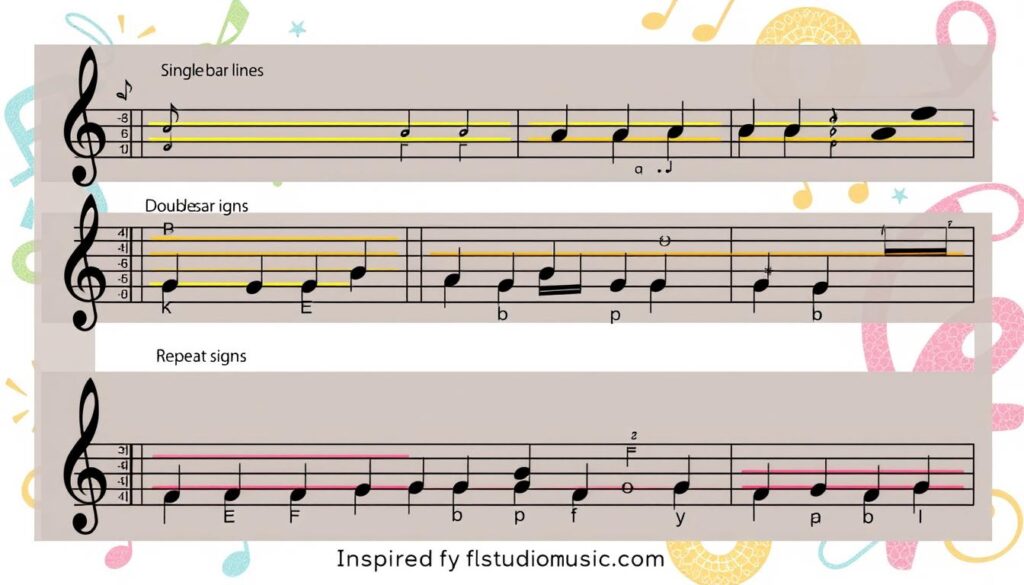
Common time signatures like 4/4, 3/4, and 2/4 are well-known. They group notes into pairs, making rhythms simpler. This makes music easier to follow.
Compound time signatures are different. They show notes grouped in threes, like 6/8, 9/8, and 12/8. Each signature has its own role in music, adding emotion and structure.
Here’s a table to help understand different time signatures:
| Type of Time Signature | Examples |
|---|---|
| Simple Duple | 2/2, 2/4, 2/8 |
| Simple Triple | 3/2, 3/4, 3/8 |
| Simple Quadruple | 4/2, 4/4, 4/8 |
| Compound Duple | 6/2, 6/4, 6/8 |
| Compound Triple | 9/2, 9/4, 9/8 |
| Compound Quadruple | 12/2, 12/4, 12/8 |
| Complex Time Signatures | 5/4, 7/8, 11/4 |
Time signatures like 5/4 or 7/8 are complex. They add unique rhythms to music. Mixed meter music, with changes like 4/4 to 3/4, also adds complexity.
Polymeter is when different time signatures mix in one piece. Joan Osborne’s “Right Hand Man” is an example, blending 2/4 with 7/4. This technique has been popular since the 19th century and is still used today.
Learning about time signatures helps us appreciate music’s variety. It shows how different genres and styles are created.
Understanding Beats Per Bar in Musical Notation
The time signature is key in music, showing how many beats are in each bar. It also tells us what kind of notes to play. For example, the 4/4 time signature means there are four quarter-note beats in each bar.
Many modern music styles like salsa, hip-hop, and pop use this time signature. It’s a common part of today’s music.
The Role of the Time Signature
Time signatures greatly affect how we hear rhythm. A 2/4 time signature means two quarter notes per bar. On the other hand, 12/8 means twelve eighth-note beats in each measure.
Knowing these values helps musicians understand music better. Time signatures that are not regular offer a different feel, with less symmetry.
Differentiating Between Simple and Compound Time Signatures
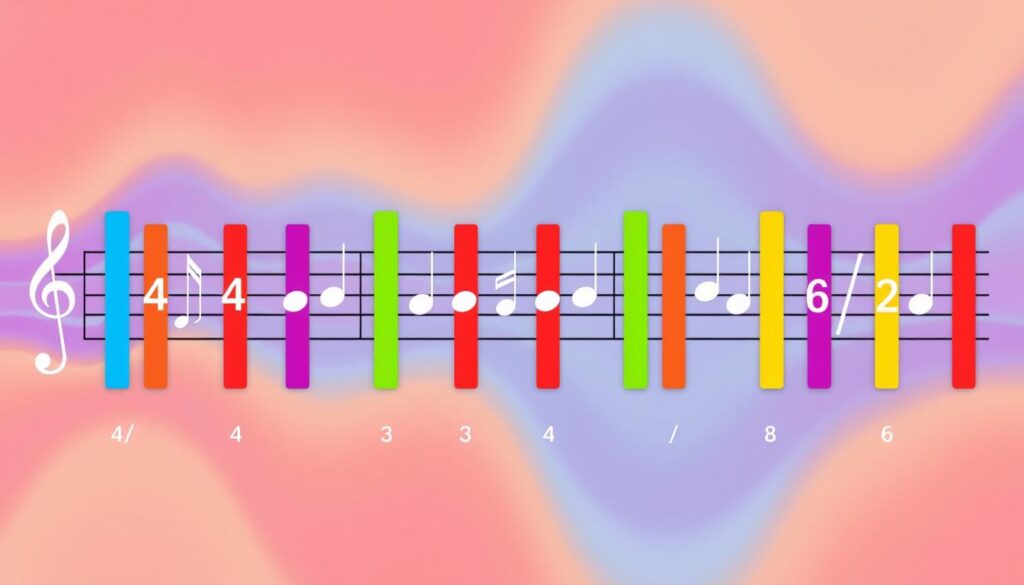
Time signatures can be simple or compound. Simple time signatures, like 4/4, divide main beats into two sub-beats. Compound time signatures, such as 6/8, divide main beats into three sub-beats.
Composers use both types to add variety to their music. They mix straightforward bars with rhythms that skip beats.
| Time Signature | Beats Per Bar | Notes Per Beat | Example Genres |
|---|---|---|---|
| 4/4 | 4 | Quarter Note | Salsa, Hip-Hop, Pop |
| 2/4 | 2 | Quarter Note | Marches, Polkas |
| 6/8 | 6 | Eighth Note | Jazz, Blues |
| 12/8 | 12 | Eighth Note | Rock, R&B |
By understanding beats per bar and time signatures, musicians improve their timing. This knowledge helps in creating and performing music.
How Time Signatures Affect Rhythmic Units
Time signatures are key in music, shaping rhythmic units in songs. Each signature tells us how many beats are in a measure and which note gets one beat. This knowledge is crucial in music theory.
The common time signatures like 2/4, 3/4, and 4/4 set the music’s pulse. Each beat matches the note value shown by the time signature. Simple meters make it easy for musicians to follow the rhythm.
Compound time signatures, like 6/8, 9/8, and 12/8, add complexity. They have beats that are multiples of three. For example, 6/8 feels like a two-in-a-bar rhythm, unlike the usual three.
Some time signatures are more common in music. The 4/4 time is found in many genres, from classical to rock. But, time signatures like 5/4 or 7/4 are less common. They add a challenge for composers and performers.
Composers like Gustav Holst and Igor Stravinsky have used these complex rhythms. Their works, like “Mars, the Bringer of War” and “The Firebird,” show how rhythmic units can be used creatively.
Time signatures can change, showing music’s flexibility. For example, a 3/4 piece can become 3/8. This allows musicians to try different interpretations, keeping the song’s essence while changing its rhythm.
The Importance of Counting Beats in a Bar
Learning to count beats in a bar is key for musicians wanting to improve their musical performance. Each bar has a specific time signature, which tells us how many beats are in it. For example, in 4/4 time, there are four beats, with each quarter note being one beat. This helps me keep the right timing during a show.
Counting beats helps musicians stay in sync, especially when playing together. In 3/4 time, or waltz time, I count ‘1-2-3’ to keep everyone in rhythm. Knowing different time signatures also lets me easily switch between different speeds, like moving from 6/8 to 4/4.
Different tempos are measured in Beats Per Minute (BPM). For example, “Allegro” means a speed of 120 to 168 BPM. Knowing this, along with how many beats are in a bar, helps me stay in sync during performances. Here’s a quick look at some common time signatures:
| Time Signature | Beats Per Bar | Notes Per Beat | Example Counting |
|---|---|---|---|
| 4/4 | 4 | Quarter note | 1-2-3-4 |
| 3/4 | 3 | Quarter note | 1-2-3 |
| 2/2 | 2 | Half note | 1-2 |
| 6/8 | 6 | Eighth note | 1-2-3-4-5-6 |
Counting beats correctly lets me share the music’s intended feeling and phrasing. Mastering this skill is vital for great musical interpretation and teamwork.
Recognizing Common Time Signatures
As a musician, knowing common and irregular time signatures is key. Common ones like 4/4, 3/4, and 2/4 are the backbone of many musical styles. On the other hand, irregular ones like 5/4 or 7/8 add a unique twist, changing the feel of a song. Let’s look at some examples to see why they matter in music theory.
Examples of Common and Irregular Time Signatures
| Time Signature | Beats Per Measure | Note Value for One Beat | Common Uses |
|---|---|---|---|
| 4/4 | 4 | Quarter Note | Pop, Rock, Classical |
| 3/4 | 3 | Quarter Note | Waltzes, Folk Songs |
| 2/4 | 2 | Quarter Note | Marches, Polkas |
| 2/2 | 2 | Half Note | Fast Pieces |
| 6/8 | 6 | Eighth Note | Dances, Rock Anthems |
| 5/4 | 5 | Quarter Note | Modern Jazz |
| 7/8 | 7 | Eighth Note | Progressive Rock, Balkan Music |
I practice exercises to get better at recognizing these time signatures. Learning their unique features helps me perform better and think more creatively. Time signatures are the foundation of music, leading to a deeper understanding of its rhythm. This journey enriches my love for music.
Conclusion
Learning about beats per bar is key to understanding music. It helps me see music in a new light. By looking into time signatures, bars, and music notation, I’ve grown to love music’s rhythm.
Time signatures are crucial. They set the pace and mood of a song. This makes me appreciate the emotions and feelings in music more.
Thinking about how music notation has changed shows me the importance of bar lines. They started in the late 16th century. They help us follow rhythms and complete musical ideas.
Knowing about different bar lines is also important. It lets me see the depth and complexity of music. This makes music even more interesting.
In summary, my exploration of beats per bar and time signatures has given me a solid base. This knowledge improves my musical skills and opens up new creative possibilities. I’m excited to use this knowledge in my music practice and performances.
FAQ
What is a time signature in musical notation?
A time signature shows how many beats are in a measure and what note value is one beat. It’s usually two numbers, like 4/4 or 3/4.
How do bars and measures relate to beats per measure?
Bars, or measures, are parts of music with a set number of beats. The time signature tells us this number. Each measure helps organize the rhythm.
What is the significance of bar lines in music notation?
Bar lines are vertical lines in music that separate measures. They show where one measure ends and another starts. This keeps the music’s structure.
Can you explain the difference between common and irregular time signatures?
Common time signatures, like 4/4 and 3/4, have regular rhythms. Irregular ones, such as 5/4 and 7/8, add unique rhythmic challenges. They change the piece’s feel.
How does the time signature influence rhythmic units in music?
The time signature sets the music’s pulse and how it’s divided into smaller notes. This shapes the rhythm and feel of the music.
Why is counting beats in a bar essential for musical performance?
Counting beats helps musicians keep rhythm. It lets them play in sync with others. This is key for good music in groups.
What are the different types of bar lines used in music notation?
Regular bar lines mark the end of a measure. Double bar lines show a change in the music. Repeat signs mean to play a section again. All help with accurate performance.
What role do simple and compound time signatures play in music?
Simple time signatures, like 4/4, have main beats divided into two parts. Compound time signatures, such as 6/8, have main beats divided into three parts. This affects the rhythm’s feel and complexity.
Source Links
- https://prodigies.com/what-is-a-bar-in-music/
- https://www.vaia.com/en-us/explanations/music/musical-notation/bar-lines/
- https://www.skoove.com/blog/time-signatures-explained/
- https://solfeg.io/article/basics-of-time-in-music-notation-beat-bar-time-signatures
- https://www.musiclever.com/en/courses/bar
- https://en.wikipedia.org/wiki/Bar_(music)
- https://library.fiveable.me/key-terms/ap-music-theory/bar-line
- http://lilypond.org/doc/v2.24/Documentation/notation/bars
- https://archive.steinberg.help/dorico/v3.5/en/dorico/topics/notation_reference/notation_reference_barlines/notation_reference_barlines_types_r.html
- https://www.libertyparkmusic.com/musical-time-signatures/
- https://richterguitar.com/time-signatures-definitions-examples-and-how-to-guide/
- https://blog.flat.io/how-the-time-signature-works/
- https://library.fiveable.me/key-terms/introduction-to-musicianship/bars
- https://en.wikipedia.org/wiki/Time_signature
- https://courses.lumenlearning.com/suny-musicappreciationtheory/chapter/time-signature/
- https://viva.pressbooks.pub/openmusictheory/chapter/simple-meter-and-time-signatures/
- http://www.cyberflotsam.com/Music_Rhythm1.htm
- https://courses.lumenlearning.com/suny-musicappreciationtheory/chapter/measures-and-time-signatures/
- https://www.vaia.com/en-us/explanations/music/musical-notation/time-signature/
- https://goodmusicacademy.com/the-complete-guide-to-music-bar-lines/
- https://ultimatemusictheory.com/incomplete-measure/
- https://www.musical-u.com/learn/introduction-to-time-signatures/